Last updated 2026-08-18
TL;DR
Alabama has no lavender farm license. You need a nursery license only if you sell live plants, a county business privilege license, and standard tax registrations. First-year costs run $4,000 to $22,000 per planted acre, with the high end covering irrigation and processing. From bare dirt to a real harvest is 2 to 3 years. The hard part is one full season of soil work, not paperwork.
Do you need a license for a lavender farm in Alabama?
No. Alabama has no 'lavender farm license.' The closest thing with a state agency behind it is a nursery license, and that only kicks in if you sell live plants or propagative stock. Grow lavender for cut bundles, dried buds, essential oil, or U-pick where customers cut their own stems, and you skip the Alabama Department of Agriculture and Industries (ADAI) nursery license entirely.
Here is the exact line. Anyone who 'sells, offers for sale, or distributes nursery stock' in Alabama needs a nursery license [1]. Lavender in a pot or a rooted cutting is nursery stock. Lavender stems, oil, and hydrosol are not. The statute defines nursery stock as plants 'for propagation or planting' [1], not harvested product.
What you will need no matter what is a county business privilege license, assuming your farm is an organized for-profit business. Every Alabama county requires one under Code of Alabama § 40-12-64 [2]. Fees run off gross receipts brackets and vary by county, but a small first year usually costs $50 to $150. Ask your county probate judge or license commissioner.
Sell anything at retail and you also register for a state sales tax license. You then collect Alabama's 4% state rate plus local rates, which average another 5% [3].
How much does it cost to start a lavender farm in Alabama?
Real first-year costs for a small Alabama lavender farm run about $4,000 to $22,000 per planted acre. The spread comes from soil type, site prep, and whether you irrigate. Three numbers drive the total: land prep, plants, and infrastructure.
Plugs from Pacific Northwest growers cost $2.00 to $4.50 each, with Spanish and lavandin varieties at the low end and true angustifolia at the high end. At 3-foot spacing that's roughly 4,800 plants per acre, or $9,600 to $21,600 for plants alone [4]. A quarter-acre farm cuts that to $2,400 to $5,400.
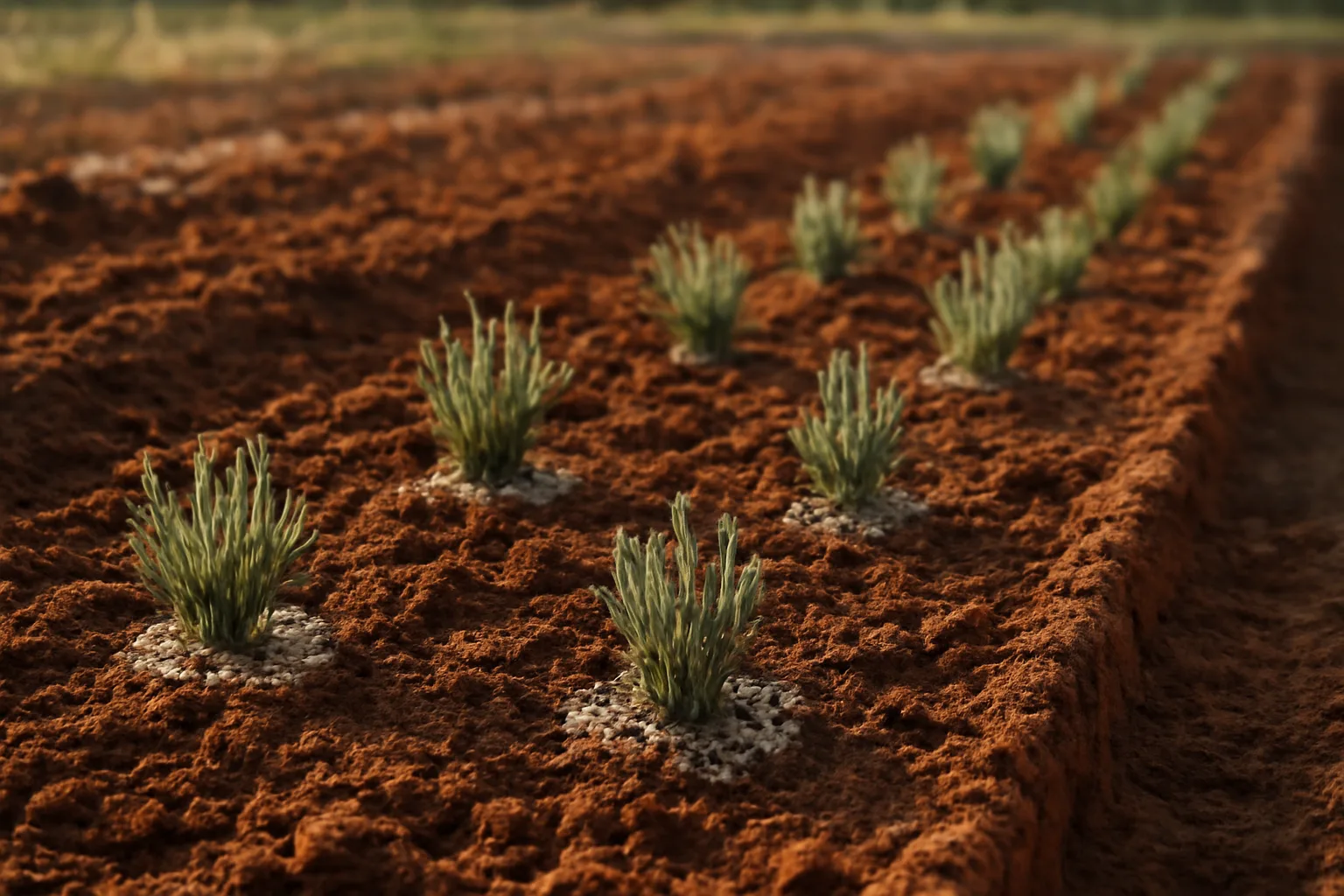
Alabama clay is the real cost driver. Lavender dies in wet feet. You will probably need raised beds, coarse sand in volume, or gravel-based drainage layers. That runs $800 to $2,500 per acre depending on how far you haul the material [5]. A soil test from the Auburn University Soil Testing Laboratory costs $10 and tells you exactly what you're fighting [6].
Drip irrigation is not optional for establishment through an Alabama summer. A basic drip system on a quarter-acre budgets about $600 to $1,200, plus a water source tie-in [7]. Processing gear waits until year two or three. A small copper still runs $2,000 to $8,000 depending on volume [8].
Total first-year outlay for a quarter-acre planting, counting soil prep, plants, drip, and a basic tool set, lands between $4,000 and $8,000. A full acre pushes toward $22,000 with premium plugs and infrastructure.
| Expense category | 1/4 acre low | 1/4 acre high | 1 acre low | 1 acre high |
|---|---|---|---|---|
| Plants | $2,400 | $5,400 | $9,600 | $21,600 |
| Soil prep | $250 | $750 | $800 | $2,500 |
| Drip irrigation | $600 | $1,200 | $1,200 | $2,400 |
| Tools/supplies | $200 | $400 | $400 | $800 |
| Business license | $50 | $150 | $50 | $150 |
| Total | $3,500 | $7,900 | $12,050 | $27,450 |
How long does it take to start a lavender farm in Alabama?
From decision to first real harvest in Alabama, count 2 to 3 growing seasons. Paperwork takes a few days to a few weeks. The land takes a full year of soil work before you plant a thing.
Most Alabama soils need amending in spring before a fall planting, or in fall before a spring planting. Lavender wants a pH of 6.5 to 7.8 and drainage like a gravel path, not Alabama red clay [6]. If your soil test shows pH 5.2 and 40% clay, plan on a whole warm season adding agricultural lime, building raised beds, and letting rain settle the profile before you order plants. That's one growing season gone, and you should treat it as non-negotiable.
Plant in October through early November in Alabama, when the heat breaks but roots still get weeks to set before winter [9]. A September decision on decent soil might put 500 plugs in the ground within 30 days. Bad soil, and you wait until the following October.
Plants throw roughly 6 to 12 stems at one year old, 30 to 50 at year two, and a full commercial cut at year three. So the timeline reads: Year 0 is site prep. Year 1 is planting, establishment pruning, a very light harvest. Year 2 is first real yield. Year 3 is full production [9]. Any grower promising 'harvest this summer' from a spring planting on unworked Alabama soil is selling you something.
A nursery license application, if you need one because you sell plant starts, takes 2 to 4 weeks at ADAI [1]. Your county business license is same-day if you show up in person with a check [2].
What varieties survive Alabama's heat and humidity?
Pick the wrong variety in Alabama and you get a dead field by August. Selection comes down to humidity tolerance more than USDA zone. Alabama spans zones 7b through 8b, which is fine for winter hardiness. Summer humidity is what kills.
Lavandins (Lavandula x intermedia) like 'Grosso', 'Provence', and 'Phenomenal' beat angustifolias across most of Alabama. 'Phenomenal' was trialed in hot, humid test plots and holds its foliage shape and bloom density [9]. Spanish lavender (L. stoechas) works in south Alabama and the coastal plain but blooms earlier and carries a camphor note in the oil. True angustifolias like 'Munstead' and 'Hidcote' grow in northern Alabama above I-20 if you give them 4-foot spacing in raised, gravel-amended beds.
Growers in the Southeastern Lavender Growers Association say the same thing over and over: Alabama's long, wet summers reward open plant architecture. Give lavandins 3 to 4 feet between plants, full sun, and no overhead watering.
Targeting essential oil? 'Grosso' gives the highest yield per acre in hot climates. Targeting U-pick and bundles? Mix 'Phenomenal' for June bloom and 'Grosso' for July to stretch your harvest window to about 6 weeks [9].
How do you get an Alabama nursery license?
If you plan to sell lavender plants, the law is plain: file a nursery license application with the ADAI Plant Protection Section. Code of Alabama § 2-25-1 through 2-25-13 requires that 'any person engaged in the sale of nursery stock' obtain a license [1]. The application asks for your business name, location, acreage under production, and an inspection fee.
As of this writing, the inspection fee is $50 for the first acre and $5 per additional acre, per the ADAI nursery rules [1]. Confirm the current fee with ADAI before you write the check, because it has changed before. A state inspector visits within a few weeks to check for pests and confirm your site. No inspection, no license.
A plant dealer license is separate. You need it if you buy plants wholesale and resell them without growing them out, and that carries a $25 fee [1]. Buy plugs, pot them, and sell them 6 weeks later, and you probably fall under the nursery license instead. The distinction matters. Call the ADAI Plant Protection office in Montgomery and describe exactly what you're selling.
One exemption saves most farms the trouble. Selling cut stems, dried buds, or oil at a farmers market or farm stand triggers no ADAI nursery requirement. Only live plants trigger it. Plenty of Alabama lavender farms go their whole lives without an ADAI license because they never sell a potted plant.
How do you prep soil for lavender in Alabama?
Alabama has high-clay Ultisols across roughly 70% of the state. Clay means poor drainage. Poor drainage means phytophthora root rot, which can kill lavender in two weeks. Good intentions do not fix this.
Start with a soil test from the Auburn University Soil Testing Laboratory [6]. You want pH, texture, and organic matter. If clay tops 35% of the profile by feel test, build raised beds 8 to 12 inches high. Some growers use a flat bed with 4 inches of coarse builder's sand and 2 inches of pea gravel tilled into the top horizon.
Slope is your friend. Even a 2% grade sheds water. If your site is dead flat, you either install subsurface drainage tile (costly) or build high raised beds (moderate cost). No flat clay field in Alabama ever grew healthy lavender without one or the other.
The Auburn soil test comes with a lime recommendation. Take it seriously. If your pH is 5.3, common in north Alabama Piedmont soils, you'll need 1 to 1.5 tons of dolomitic limestone per acre tilled in. Lime takes 6 months to fully react, which is exactly why year-0 land prep is not a suggestion [6].
What tax registrations does an Alabama lavender farm need?
Every lavender farm selling any product or service in Alabama needs three registrations at minimum: a county business privilege license, a state sales tax license (if you sell retail), and a federal EIN if you're anything other than a sole proprietor.
The county privilege license runs under § 40-12-64 of the Code of Alabama [2]. Each county commission sets its own fee schedule by resolution. In Baldwin County, for example, a business under $10,000 in annual gross receipts pays about $75 a year. Colbert County may be $50. Your county license commissioner or probate judge has the current brackets.
Alabama sales tax is a combined state (4%) plus local (0% to 7.5%) rate [3]. Sell directly to customers at a farm stand or U-pick event and you collect sales tax on the full sale. Wholesale sales to a registered retailer who hands you a resale certificate are exempt. Register through the Alabama Department of Revenue's My Alabama Taxes portal [3].
Hire anyone, even a weekend helper, and you need an Alabama withholding tax account through ADOR [3]. Workers' compensation insurance is then required by state law for any employee, though family members may be exempt depending on your structure.
Farms also qualify for Alabama's current-use agricultural valuation, which can cut your property tax bill hard [10]. File a current-use application with your county tax assessor. The form is simple: describe your agricultural activity and acreage. A lavender operation counts as a 'farm' under the statute if you're actively farming, more than holding land.
U-pick, agritourism, and liability rules in Alabama
Alabama has no state agritourism statute that limits liability for U-pick operations the way Georgia or Tennessee do. Your general liability exposure sits under the ordinary Alabama tort standard.
Here is what that means for a lavender farm. If a customer trips on a raised bed edge, cuts a hand on old farm wire, or reacts to bees on your site, they can sue. Alabama runs on contributory negligence, one of the few states where a plaintiff who is even 1% at fault is barred from recovery. That's a shield, but a thin one.
Get a general liability policy that spells out agritourism and farm visitors. Many standard farm policies exclude members of the public. Tell your agent you run a U-pick farm. Premiums usually run $400 to $1,200 a year for a small operation [11].
Post visible signage warning of the obvious risks: uneven ground, bees, sun, tools. Have customers sign a plain hold-harmless acknowledgment at the gate, even a clipboard. It won't immunize you against gross negligence, but it establishes notice.
Food sales add a layer. Sell lavender lemonade or baked goods at an on-farm event and Alabama Department of Public Health cottage food rules apply if you produce at home [12]. Prepare food on-site, and you may need a county health department permit [12].
How do you process and sell lavender products in Alabama?
The Alabama-specific rule that matters: farm-scale essential oil distillation needs no FDA food facility registration unless you sell the oil for human ingestion. Sell it as a cosmetic ingredient or aromatherapy oil and the path is lighter. Label it 'for external use only' and you dodge many FDA thresholds.
Dried lavender sold as a culinary herb falls under Alabama's cottage food rules if your total sales stay under the state threshold (currently $20,000 a year for cottage food operators) and you sell straight to consumers [12]. Label products with your name, address, ingredients, and the required cottage food statement: 'This food is not inspected by the Alabama Department of Public Health.'
Process other people's lavender in your still and that's a service business under your existing tax registrations. No distilling license exists in Alabama. The Alabama Department of Environmental Management (ADEM) cares about waste discharge only at industrial volume, which a farm still never reaches.
Sell value-added products through an Alabama Farmers Market Authority certified market and you get more public visibility. Certification is free and requires you prove you grow what you sell. The form is on the Farmers Market Authority website [13].
Year one: what to actually do, month by month
January to March: order your soil test from Auburn [6]. While results come back, research varieties and source plugs. Commit to a planting density. Visit another Alabama lavender farm in person, not online, and note their spacing and bed design.
March to May: lime, till, and build beds off your soil test results. If you need raised rows, this is the window while clay stays workable. Install drip irrigation before planting. You do not want to retrofit irrigation around 4,800 plants.
May to September: let the amended soil settle and ride out a full Alabama summer. This is hard to hear when you're excited, but it's the single step that separates farms that survive from farms that rot. A fall planting wants about 90 days of post-amendment settling.
October to early November: plant plugs into prepared beds. Water in deeply. Mulch around plants with pea gravel or coarse sand, never bark, which holds moisture against the crown.
December to February: protect young plants from a hard freeze if temperatures drop below 15°F. A floating row cover over a small planting is cheap insurance.
March of Year 2: prune young plants by about a third to force branching. Harvest lightly. File your county business license renewal [2].
Labor, equipment, and the stuff you will buy anyway
A quarter-acre lavender farm is hand-scale. A full acre pushes you into mechanical help at harvest and for weeding.
Minimum equipment for year one in Alabama, beyond drip components: a broadfork or tiller ($150-$600), a good hoe ($30), a soil knife ($25), harvest snips per worker ($15 each), and a wagon or cart for harvest day ($80-$200). A shade structure for drying racks is a second-year need. Fifty square feet of ventilated drying space handles about 500 plants' worth of harvested stems, and a simple hoop with shade cloth runs $400-$800.
Weeds in Alabama never quit. Landscape fabric is a common choice in lavender rows. A quarter acre with 12 rows, each 60 feet, needs about 720 linear feet of 4-foot fabric, which costs $180-$300 [7]. Some north Alabama growers report better results with a 3-inch gravel mulch layer, because fabric can trap moisture against crowns in August.
Harvest labor: one worker cuts about 100 to 150 lavender bundles an hour in a well-spaced field. A 1,000-plant field at first harvest yields roughly 600 to 1,200 bundles, so one person in 8 hours can cover a quarter-acre U-pick or market harvest. By year three, the same field yields 3,000 to 5,000 bundles, and you'll want friends or hired help for harvest week.
A word on cost transparency and the path forward
No national farm cost estimator is accurate for Alabama lavender, because land, soil prep, and humidity pressure are all state-specific. The closest honest data set comes from Southeastern Lavender Growers Association member surveys, which report small-farm start-up costs in the $4,000 to $18,000 range for a quarter to half acre, with the wide spread coming from soil prep [5].
If you want a vetted paper-and-steps path without seminars and markups, a one-time resource like the LavenderKit Cultivar + Distill + U-Pick Kit at /start puts licensing, planting specs, and distilling math into a single reference. It is not a service and not legal advice, but it maps the process from Alabama soil test to label compliance.
The real decision you face is not whether a license exists. It is whether your land drains in August. Find that out for $10 and a shovel before you spend $5,000 on plants.
Frequently asked questions
Do I need a state license to grow lavender in Alabama?
No state license is required to grow lavender for harvested product (cut stems, dried buds, essential oil) in Alabama. A nursery license from the ADAI Plant Protection Section is required only if you sell or distribute live lavender plants. Most Alabama lavender farms never hold a nursery license because they sell processed product, not live plants.
What is the cheapest way to start a lavender farm in Alabama?
Start with a quarter-acre on already-drained sandy-loam soil, which erases most soil prep cost. Plant lavandin plugs at $2.00 each on 4-foot spacing, so you need fewer plants. Use hand-laid drip tape instead of emitters. Total first-year spend can stay under $3,500 with a county business license, 500 plants, basic tools, and minimal amendment. A soil test first saves you from planting into death clay.
How long until I can sell lavender products?
You can harvest a small number of stems in year one, roughly 6 to 12 per plant, enough for a modest first farm stand appearance. Commercial volume arrives in year 3. Essential oil distillation needs enough biomass to run the still economically, typically year 3 at the earliest. Bundles and dried buds reach marketable quantity by year 2.
Does Alabama have grants or loans for lavender farms?
Alabama has no lavender-specific grant. USDA programs including the Environmental Quality Incentives Program (EQIP) through NRCS may cover high tunnel or irrigation cost-share if your farm qualifies as an agricultural operation. Alabama's Agricultural and Conservation Development Commission offers small grants for marketing and processing infrastructure. Check with your county USDA Farm Service Agency office.
Can I run a U-pick lavender farm on residential property in Alabama?
It depends on county zoning. Agricultural-zoned land with an agritourism overlay allows it with few restrictions. Residential-zoned land may bar commercial traffic and on-site sales. Many Alabama counties define agritourism broadly, but confirm with the county planning department. A business privilege license is required regardless, and neighbors may object to parking on a residential road.
What insurance does a lavender farm need in Alabama?
A general liability policy with agritourism coverage is recommended for any farm that invites public visitors. A standard farm policy often excludes paying guests. Workers' compensation is required if you have employees. Property insurance on processing buildings and equipment is optional but smart. Expect to pay $600 to $1,500 a year for combined coverage on a small farm.
Where do I buy lavender plants for an Alabama farm?
Most commercial lavender farms source plugs from specialty growers in the Pacific Northwest or California, which ship nationwide by air. Southeastern growers sometimes offer regionally acclimated stock. Avoid big-box store lavender starts, which are often mislabeled varieties and may have been greenhouse-forced in ways that fail in Alabama field conditions. Order plugs 6 months before your planned planting date.
Is lavender farming profitable in Alabama?
A well-run acre in full production (year 3 and beyond) can gross $20,000 to $40,000 a year across U-pick admissions, fresh bundles, dried buds, and oil. Net profit hinges on labor and processing setup. Most Alabama lavender farms are side income, not a sole livelihood. Profitability needs a strong direct-to-consumer channel: farmers markets, on-farm events, and online sales.
Do I need a pesticide applicator license for lavender in Alabama?
Lavender growers rarely need a restricted-use pesticide license, because pests are minor compared to vegetables. Scale insects and spittlebugs occasionally need treatment. A commercial pesticide applicator permit from ADAI is required only if you apply pesticides for hire on other properties. Over-the-counter insecticidal soap and neem oil require no license.
How do I register my lavender farm name in Alabama?
If you operate under a trade name (not your legal personal name), Alabama has no statewide fictitious business name registration. Many counties instead put the trade name on the business privilege license application. If you form an LLC or corporation, file with the Alabama Secretary of State. A federal EIN from the IRS is free and takes 10 minutes online.
What counties in Alabama are best for lavender?
Higher-elevation, better-draining counties like DeKalb, Jackson, Marshall, and Cherokee in north Alabama have favorable soil and slightly cooler summers. Baldwin County's sandy loams near the coast work if you choose Spanish lavender varieties. The Black Belt region's heavy clay is the toughest and demands the most soil amendment investment.
Can I sell lavender at Alabama farmers markets without a license?
You need a state sales tax license for any retail sale, including at a farmers market. A county business privilege license is also required. No extra food safety license is needed for dried lavender or fresh stems. For lavender baked goods or infused products, Alabama cottage food rules apply if annual sales stay under $20,000 and you sell direct to consumer [12].
Sources
- Alabama Department of Agriculture and Industries, Plant Protection: Anyone who sells, offers for sale, or distributes nursery stock in Alabama needs a nursery license; live plants trigger the requirement, harvested product does not.
- Code of Alabama § 40-12-64, county business privilege license authority: County governments require business privilege licenses with fees set by county commission based on gross receipts brackets.
- Alabama Department of Revenue, Sales and Use Tax overview: Alabama imposes a 4% state sales tax rate plus local rates averaging 5% added; retail sellers must register for a sales tax license through My Alabama Taxes.
- Johnny's Selected Seeds, Lavender Plugs wholesale pricing, 2025 catalog: Commercial lavender plugs from wholesale suppliers range from approximately $2.00 to $4.50 per plant depending on variety and volume.
- Alabama Cooperative Extension System, small-farm production cost guidance: Soil prep on Alabama clay commonly runs hundreds to a few thousand dollars per acre depending on haul distance and bed construction.
- Auburn University / Alabama Cooperative Extension soil testing: A routine soil test from the Auburn University Soil Testing Laboratory costs $10 and includes pH and lime recommendations.
- DripWorks, small farm drip irrigation kit pricing, 2025: A basic quarter-acre drip irrigation kit with tape, fittings, and filter costs approximately $600 to $1,200 depending on row layout and emitter spacing.
- USDA, small-farm processing equipment context: Small-scale copper essential oil stills range from $2,000 to $8,000 depending on capacity from 5 to 20 gallons.
- US Lavender Growers Association, Lavender Variety Recommendations for USDA Zones 7-8, 2023: 'Phenomenal' lavandin was trialed for heat and humidity tolerance and holds form well in southeastern zones; lavandins outperform angustifolias in humid climates.
- Code of Alabama § 40-7-25.1, current use valuation for agricultural property: Agricultural land actively used for farming qualifies for current-use valuation reducing property tax assessment.
- Alabama Department of Insurance: A general liability policy that covers farm visitors commonly prices in the low hundreds to about $1,200 a year for a small U-pick operation.
- Alabama Department of Public Health, Cottage Food Operations guidance, 2023: Cottage food operations in Alabama may sell up to $20,000 of non-potentially hazardous food annually direct to consumer if labeled with required statement.
- Alabama Farmers Market Authority, grower certification program, 2024: Free certification verifies you grow what you sell and allows participation in authenticated farmers markets statewide.